
API 17K crossover hose is a type of flexible connecting pipeline product designed specifically for offshore oil and gas development. It is used in offshore facilities such as floating production storage and unloading units, fixed platforms, tension leg platforms, and floating liquefied natural gas units to transport production fluids, injection media, and utility media across equipment. Its typical application scenarios include: crude oil and water injection transportation between platforms and single point mooring systems, multi-media transmission between piers and production platforms, fluid connections between floating production units and underwater production systems, and natural gas transportation between floating storage and gasification units and docks or fixed facilities.
The core technical specification followed by this product is API Spec. 17K "Specification for Adhesive Flexible Pipe". This standard system specifies the minimum requirements for the design, material selection, manufacturing, testing, labeling, and packaging of adhesive structure flexible pipes, and is applicable to application scenarios such as oil and gas production, output, injection, and seawater intake. The product forms covered by the standard include crossover pipes, risers, streamline pipes, and offshore loading and unloading hoses, which can serve sweet and acidic medium working conditions.
It should be noted that API 17K is not applicable to the throttling and killing pipeline of the blowout preventer, and this application corresponds to the API 16C standard; It also does not cover flexible pipes with non bonded structures, which correspond to the API 17J standard. The three belong to different technical systems, and when selecting, it is necessary to accurately distinguish them based on the application scenario.
2、 Technical principle of adhesive structure
The API 17K crossover hose belongs to the adhesive flexible pipe, and its core process feature is that the pipe wall is alternately stacked with rubber layers and metal reinforcement layers, and then bonded into a whole through vulcanization process. During the vulcanization process, rubber undergoes cross-linking reaction, forming a strong chemical and mechanical bond with the reinforcement layer, and the pipe wall becomes a solid structure without voids.
This structural feature determines the performance difference between bonded flexible pipes, steel pipes, and non bonded flexible pipes. The adhesive structure ensures that the load is uniformly transmitted to each reinforcement layer through the adhesive interface when the pipe is subjected to internal pressure, avoiding interlayer slip and relative motion, thereby maintaining structural stability under high pressure conditions. At the same time, the cross-linked network of rubber ensures that the pipe wall does not melt at high temperatures, but responds to flame exposure through combustion, providing a material basis for fire protection design.
3、 Multi layer composite structure design
The API 17K crossover hose adopts a multi-layer composite structure, and each functional layer cooperates in the order from inside to outside to achieve medium sealing, pressure bearing, gas emission, and external protection functions.
Inner lining layer: directly in contact with the conveying medium, the material selection depends on the working conditions. Common materials include hydrogenated nitrile rubber, which is suitable for acidic media containing hydrogen sulfide and for transporting crude oil and natural gas; Polyamide is suitable for specific chemical media; For working conditions that require lower friction coefficients or higher chemical stability, ultra-high molecular weight polyethylene or polytetrafluoroethylene can be used as lining materials. The thickness of the inner lining layer is usually around 4.0mm, depending on the working pressure and pipe diameter.
Internal metal skeleton layer: In some structures, there is a skeleton layer wrapped with interlocking metal strips outside the inner lining layer, made of 316L or 254 SMO grade stainless steel. The function of this layer includes: protecting the polymer lining from mechanical damage; Prevent foaming of the inner lining caused by rapid pressure reduction under high-pressure gas conditions; Provide support for the pipe wall to maintain its shape and facilitate cleaning operations. The interlocking structure of the metal skeleton keeps the tube flexible even when bent.
Enhancement layer: The main load-bearing structure of the pipe body that bears internal pressure. The reinforcement layer is applied by spiral winding multiple layers of high tensile strength steel wire rope or steel cord, and the surface of the steel wire is galvanized or brass plated to provide anti-corrosion protection. The number of reinforcement layers determines the pressure bearing capacity of the pipe body, and multi-layer winding can provide working pressure bearing from several MPa to over 30 MPa. In some structural designs, the reinforcement layer may include a composite weaving of aramid fibers and steel wires to achieve a balance between compressive capacity and weight.
Anti permeability and exhaust layer: When adhesive flexible pipes transport gas containing fluids, gas molecules may penetrate through the inner lining layer and enter the pipe wall. For this purpose, a gas guiding layer is installed in the pipe wall to guide the permeable gas to the exhaust hole in the joint area for discharge, preventing gas accumulation between layers and causing the pipe body to swell. The buffer layer in the joint area is equipped with multiple exhaust channels, which guide the gas to the outside of the compression groove exhaust pipe.
Outer protective layer: The outermost layer is made of weather resistant synthetic rubber, which resists seawater corrosion, UV aging, ozone erosion, and mechanical wear. In working conditions with a high risk of mechanical damage, stainless steel interlocking armor can be added to the outer layer, made of 316L or 254 SMO, to provide impact resistance, wear resistance, and cutting resistance protection.
4、 Joint design
The joint design and pipe body manufacturing of API 17K crossover hose are deeply integrated. In high demand applications, the joint, as a component of the pipe body, is vulcanized together with the pipe body during the manufacturing process to form a complete structure.
The design principle of the joint is that the strength of the joint must be higher than that of the pipe itself, ensuring that the pipe fails before the joint under the design pressure. This design concept is achieved by anchoring the end of the reinforcement layer inside the joint - when the pipe body is subjected to internal pressure, the reinforcement layer is subjected to outward radial force, making the bonding between the reinforcement layer and the joint body more tight. In some designs, the reinforcement layer is fixed to the joint body through epoxy bonding; In other designs, the reinforcement layer is fixed outside the joint by circumferential wrapping.
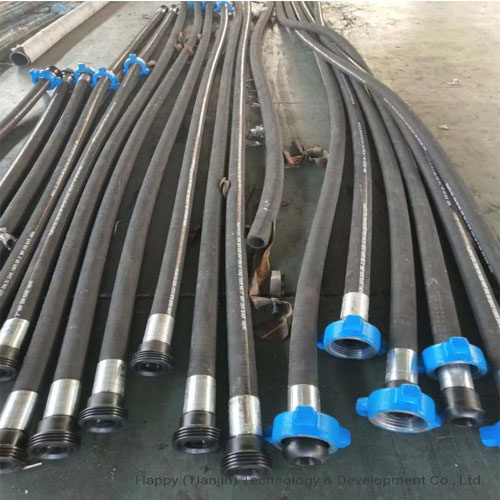
The joint material is usually carbon steel or duplex stainless steel, which must meet the requirements of sulfide stress corrosion resistance. End connection forms include flanges, hammer joints, etc
Online Message
Please fill in your name and message, and don't forget to email and/or call if you wish. We will reply within 24 hours.
